2026 Primary: August 8 General: November 3 Official election information

Issues & Research · Housing

Oʻahu Doesn’t Actually Have a Housing Crisis.

Oʻahu has homes. Who gets them?

The affordability crisis is real. The question is whether Hawaiʻi is diagnosing it correctly. Before assuming we need tens of thousands of additional homes, we should determine how much of the housing we already have is unavailable to year-round local residents because of competing uses.

Research updated October 2026Main finding: use existing housing firstSources and methodology below
Main finding · Housing

Do not assume the answer is tens of thousands of new homes before measuring the homes already here.

The 2024 Hawaiʻi Housing Planning Study distinguishes between the number of physical housing units and the stock available to the resident market. That distinction is central to this research.

Oʻahu’s housing stock can simultaneously serve year-round residents, second-home owners, visitors, investors, corporations, and speculative buyers. Ownership alone does not establish that a home has been diverted from residents, but use matters. A nonresident-owned home rented long-term to a local household still contributes to resident supply. A second home, short-term rental, or deliberately vacant investment generally does not.

372,456Total Honolulu County housing units in the 2022 HHPS baseline
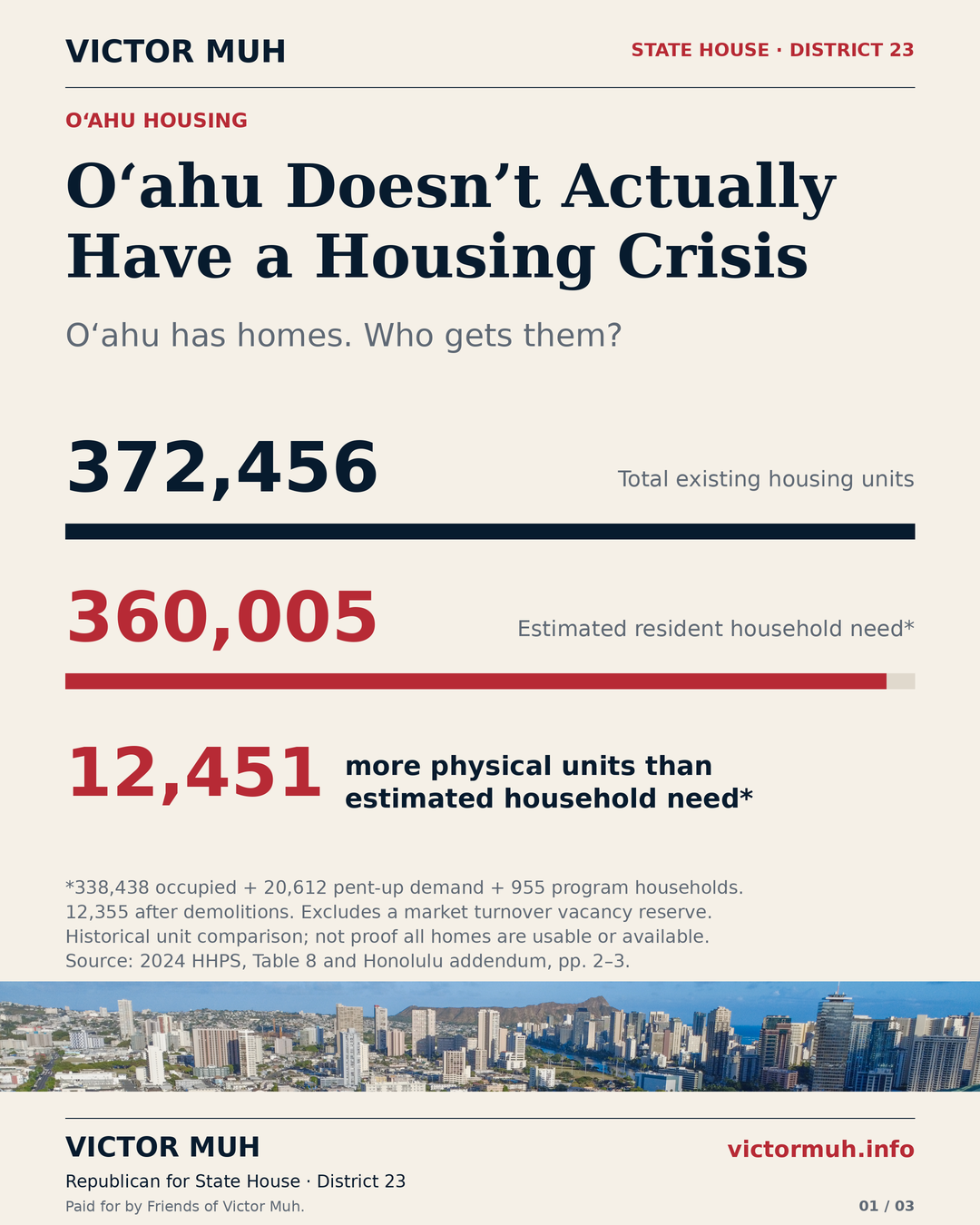
351,557HHPS available housing stock in that baseline
20,899Difference between total units and available stock, not a count of investor vacancies
Research question that should come before an automatic build target: How many existing homes are unavailable to year-round local households because of second-home use, short-term rental use, prolonged vacancy, or other speculative and nonresident uses, and how many of those homes can realistically return to resident use?

Start with the inventory

Oʻahu had 372,456 physical housing units in the state study’s 2022 baseline.

372,456Total Honolulu County housing units2022 baseline, HHPS Table 8.
351,557Available housing stock2022 baseline, HHPS Table 8.
20,899Difference between the twoThis is not the same thing as investor-held vacancy, and not every unit is usable or convertible.

Physical-inventory lens

Occupied units338,438
Pent-up demand+20,612
Households leaving homelessness+492
Residential public-service households+463
Calculated resident requirement before market reserve360,005
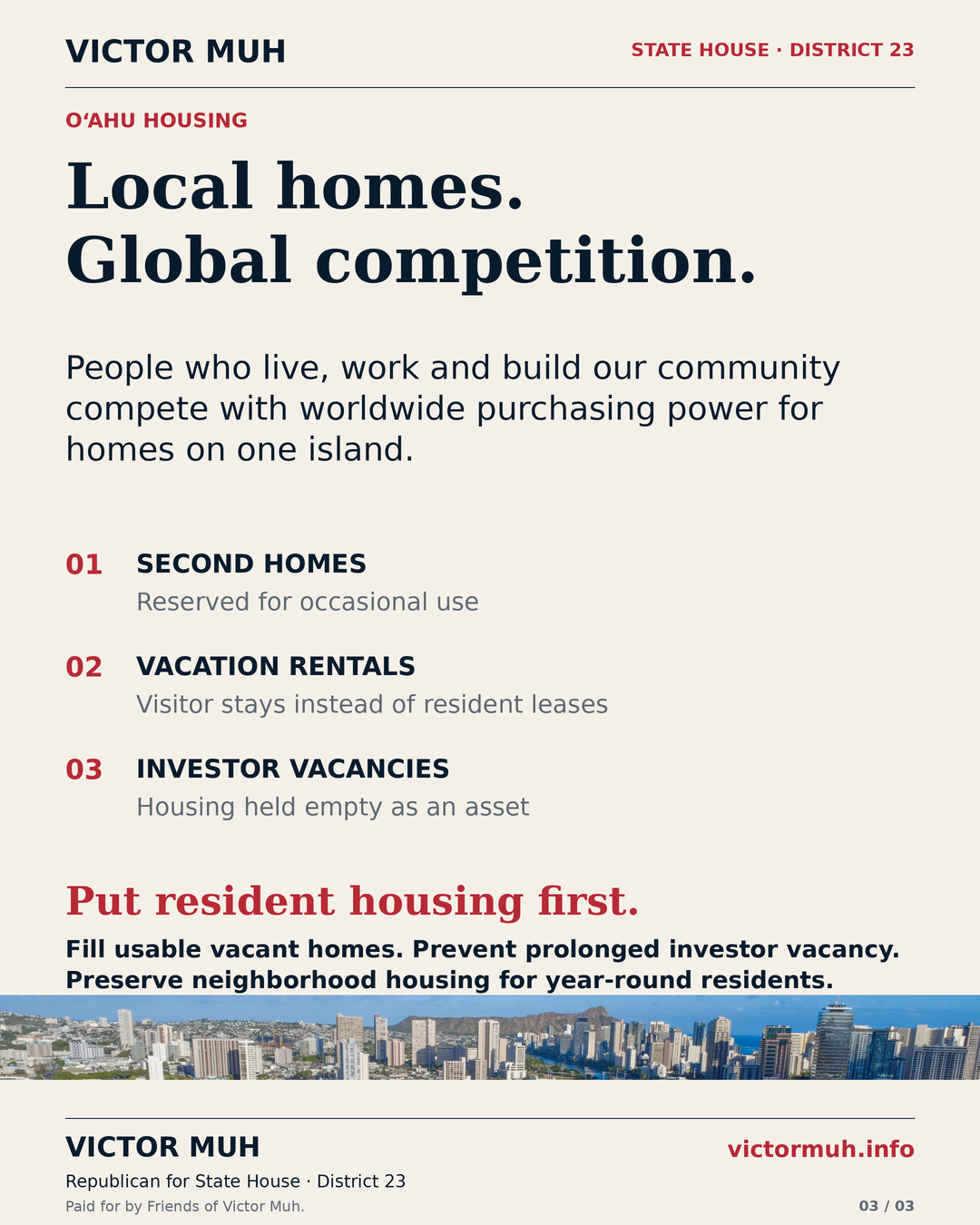
372,456 physical units less 360,00512,451

This is a campaign calculation from the Honolulu addendum. It intentionally excludes the market-turnover reserve so we can ask a narrower question: how does the number of physical homes compare with resident household requirements before reserving additional vacant units for market function?
HHFDC’s official availability lens

Occupied units338,438
Vacant and available units+13,119
Demolitions-96
Adjusted resident supply351,461
Adjusted resident demand, including market reserve373,124
Official estimated shortage at end of 202221,663

The state model includes 13,119 vacant and available units as “swap space” needed for normal market function. It does not count housing held outside the resident market as resident supply.

What this means: The state’s official model does find a shortage of housing available to residents. My policy question is whether more of the existing physical inventory can be returned to resident use before government assumes that every unmet need must be solved by building an equivalent number of new units.

Competing uses

Before calling for more construction, measure how the existing stock is being used.

Year-round resident housing

Owner-occupied homes and long-term rentals serving people who live here are part of resident housing supply, regardless of whether the owner is local, nonresident, individual, or corporate.

Second homes

Homes reserved primarily for occasional use exist physically but are not available for full-time resident occupancy.

Short-term rentals

Housing used for short stays serves visitor demand instead of year-round resident demand when it is drawn from ordinary residential stock.

Investor-held vacancies

Homes deliberately kept empty as assets do not house residents. This is different from an investor-owned home rented to a year-round household.

Nonresident ownership

Nonresident ownership should be measured by use. A nonresident-owned home occupied by a local tenant remains resident housing; an occasional-use or empty property does not.

Corporate or speculative ownership

Corporate ownership is not automatically a competing use. The research question is whether the ownership structure results in long-term resident occupancy, short-term use, or prolonged vacancy.

Data limitation: The 20,899-unit difference between total housing units and HHFDC’s available housing stock is not a verified count of units diverted to these uses. A defensible policy should quantify each category before assigning a construction target.

Population and demand

Population can flatten or decline while competition for homes remains intense.

Resident population can weaken

  • High housing costs can push residents to leave.
  • People may delay forming independent households locally.
  • Population growth can slow while the number of households still changes.

Housing competition can remain strong

  • Visitor and vacation use competes for some housing.
  • Second homes remove some units from full-time occupancy.
  • Some investor purchases leave homes empty or underused.
  • Higher-income outside buyers can bid against local households.
  • Smaller households can require more homes per resident.

The practical question is not simply “How many people live here?” It is “How many homes are available for year-round residents at prices residents can afford?”

Policy conclusion

Make existing housing available to local working families first.

Victor Muh · Housing policy conclusion
“My priority is to make the housing we already have available to local working families first. Hawaiʻi is an island state with limited land. We should not assume that endless construction is the answer while existing homes are being used as investment assets, vacation properties, or places for people who do not live here. Only after we address competing uses and determine the true remaining housing need should we consider how much additional housing, if any, is actually necessary.”
01

Audit competing uses

Build a credible Oʻahu inventory that separates year-round resident housing from second homes, short-term rentals, prolonged vacancies, and other uses that keep housing outside the resident market.

02

Fill usable vacant homes

Identify homes that are livable and can realistically return to year-round occupancy before treating every unmet household as a new-construction requirement.

03

Eliminate prolonged investor-held vacancy

The policy objective is to prevent homes from being acquired simply to sit empty. Implementation should target actual prolonged non-use rather than ordinary long-term rental ownership.

04

Protect residential neighborhoods

Residential housing should primarily house residents. Visitor-oriented accommodation should be concentrated where zoning, infrastructure, and resort capacity are designed for it.

05

Measure before setting quotas

Do not invent a numerical reduction target for second homes or short-term rentals until Oʻahu-specific data establishes inventory, occupancy, seasonality, resort capacity, and realistic conversion rates.

06

Build only for the remaining need

After competing uses are addressed and the resident inventory is measured, determine how much additional housing, if any, is actually necessary and where it should go.

Housing & reentry

Temporary housing can be a bridge to permanent independent living.

Housing instability is a separate but related problem for people returning from incarceration. A proposed Agricultural Reentry Campus would provide temporary, structured housing while eligible participants work, save money, establish employment history, obtain identification and documentation, and search for permanent housing.

Important distinction

This would be transitional reentry housing, not permanent institutional housing and not a substitute for ordinary resident housing. A campus on agricultural land should not be assumed legal merely because participants also work on a farm. Land-use approval would require site-specific review and, where necessary, new state or county authorization.

Read the full Agricultural Reentry Campuses proposal.

Shareable research

The housing argument in three graphics.

Campaign graphic comparing 372,456 total Oʻahu housing units with a calculated need for 360,005 resident households in a 2022 baseline.
01 · Physical inventory compared with calculated resident household requirement before a market-turnover reserve.
Campaign graphic showing 372,456 total housing units, 351,557 in available resident housing stock, and their calculated difference of 20,899 units.
02 · Total housing units are not the same thing as homes available to the resident market.
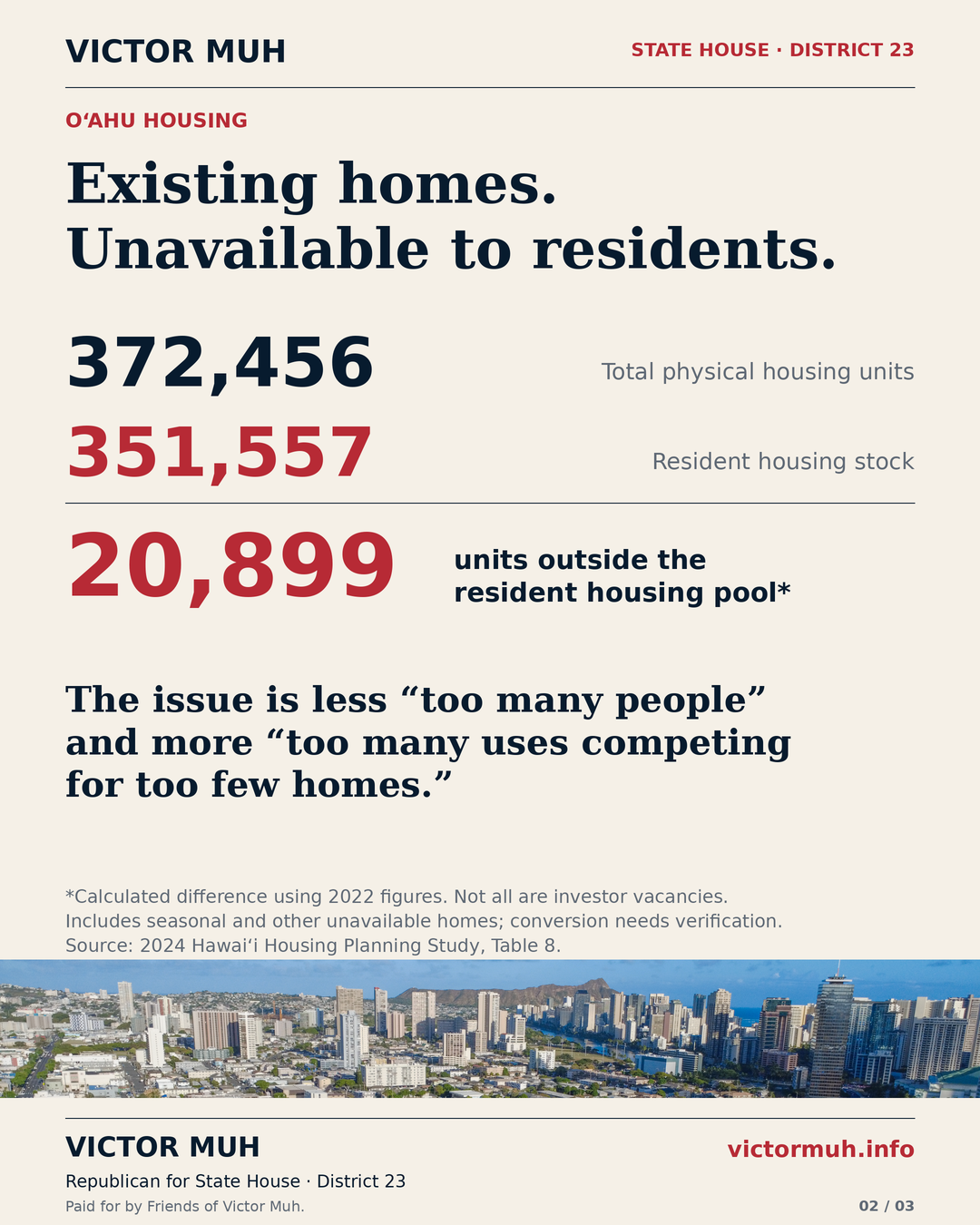
Campaign graphic explaining competition between resident housing and second homes, vacation rentals, and investor-held vacancies.
03 · The policy focus: return usable housing to year-round resident use and protect resident neighborhoods.

Sources & methodology

Show the work.

Primary housing-data source

2024 Hawaiʻi Housing Planning Study with Honolulu County Supplemental Report, Hawaiʻi Housing Finance & Development Corporation, Department of Business, Economic Development & Tourism.

  • Table 8, printed page 54: Honolulu total housing units and available housing stock.
  • Honolulu Supplemental Report, pages 2–3: occupied units, vacant and available units, demolitions, pent-up demand, housing demand, and the official shortage calculation.

Read the full HHPS and addendum

HHFDC Housing Planning Study landing page

Research note: These figures are based on the study’s 2022 baseline and are not a 2026 inventory audit. The 360,005 figure and the 12,451 physical-unit difference are campaign calculations derived from components in the Honolulu addendum before adding the market-function reserve. They are not HHFDC’s official shortage measure. HHFDC’s Honolulu methodology reports a 21,663-unit shortage at the end of 2022 after defining resident supply and including 13,119 units for market function. The 20,899-unit difference between total units and available housing stock is not equivalent to investor-held vacancies, and not all units outside the resident stock are necessarily usable or convertible.

Issues & Research

Next: Workforce & Self-Sufficiency

The next research finding examines Hawaiʻi’s projected shortage of living-wage careers and why rebuilding agriculture, food processing, manufacturing, and import-replacement industries is part of the workforce solution.

Read the Workforce Research

HousingWorkforceSelf-SufficiencyCost of LivingMore to come
VOTE VICTOR MUH

State House · District 23

Get Involved